Showing posts with label glass art. Show all posts

8/08/2012

Robin Rice Essay

Robin Rice does a wonderful job interviewing and writing about each artist that becomes a fellow at Wheaton Arts, Creative Glass Center of America. Below is a link to the her essay about my work and time at Wheaton last summer. Hope you enjoy!
Above is Betty the Black Widow who inspired 
the installation below called "Tripod"

http://www.wheatonarts.org/creativeglasscenteramerica/criticresidency/robinrice/juliusjanejessica

8/03/2012

"3 Questions"- interview on Glass Quarterly Blog

Just posted last week is an interview that asks 3 questions dealing with my creative process, inspiration, and what I am working on. I hope you enjoy it.


To see the interview please click the link below
http://blog.glassquarterly.com/2012/07/20/3-questions-for-jessica-jane-julius/#more-15150

7/04/2012

"Static" at the Philadelphia Museum of Art

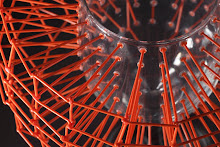
For the exhibition "Craft Spoken Here", curated by Elisabeth Agro, at the Philadelphia Museum of Art I have installed "Static". It is an installation made from thousands of black glass thread that has been flameworked and then gets connected to create one form. Each time this work gets installed it reacts to the space. I feel it is similar to drawing with a black pen on a white piece of paper.

The exhibition runs from May 5th, 2012 through August 12th, 2012. 

To see time-lapse video of the piece being installed click here.


From the PMA website
Crafts were prominent among the first works of art to enter the collections of the Philadelphia Museum of Art when it was founded in 1876, and the Museum has continued to collect and exhibit crafts. Today, thanks in large part to the Women’s Committee and gifts from individuals, the Museum is particularly well-known for its holdings of twentieth-and twenty-first-century American, European, and Asian craft.
With Craft Spoken Here, the Museum seizes the opportunity to experiment with its collection and to understand craft in an international context. Some forty contemporary works from 1960 to the present in ceramic, glass, metal, wood, lacquer, paper, and fiber—some by living, acclaimed artists and others by lesser-known creators—are on view. Representing the Americas, Africa, Asia, and Europe, the works highlight formal qualities that cross cultures, time, and media.
Craft Spoken Here features an array of engaging education programs and interpretive materials, including on-site artist demonstrations and hands-on craftmaking activities for the public.

"Passing the Torch"

Exhibition Passing the Torch at Wheaton Arts in the Gallery of Fine Craft 3/12 - 5/12.

I was asked to be a part of an exhibition on Contemporary Flameworking by Paul Stankard. It was a honor to chosen by someone with such history in the American Studio Glass Movement. Thank you Paul!

"Fraction", Flameworked bullseye glass 

Teaching at Corning

Teaching at Corning Museum of Glass- winter session
Erica Rosenfeld and I are co-teaching a course at the museum 
January 16-21, 2012


Course name - "If you can't take the heat get out of the kitchen"


Chrysler Museum

The Burnt Asphalt Family performs at the Chrysler Museum in November 2011.

To see the video click here.


11/30/2011

Wheaton Fellowship- summer 2011 some picts

I pulled miles of black cane for flameworking from the black tank of glass we had.
This is a drawing experiment that involves lots of gluing.

Springs made in the Hot Shop.

I feel so lucky to be able to have finished my second CGCA fellowship at Wheaton arts this past summer from May to July 2011. I was one of four artist during this 3 month period- Erica Rosenfeld, Brett Swenson, and Sara Pitt. During this time I was able to experiment, make components for my work, and finish an installation. Above are some picts of works in progress and the 4 of us. To see a lot more wheaton fellowship picts you can go to my facebook page.


9/02/2008

New Scribble Piece


This is the beginning of new scribble pieces, I am fusing some of the scribble flat in an attempt to control part of the chaos. This is just the first piece, many more to come.

7/25/2008

Art Critic Robin Rice wrote an Essay from an interview with me during my fellowship at wheaton arts

“We all need to understand why we are here; why we exist and how we exist,” observes Jessica Julius, a Spring 2007 Resident Fellow at the Creative Glass Center of America. Yet her work suggests that although she finds this question endlessly intriguing, it is one to which she does not postulate or expect a definitive answer.

The idea of an evolving truth makes sense in the context of Julius’s on-going interest in science, especially physiology, an area of study which is never exhausted as each answer gives rise to new questions. In various ways within her work, Julius consistently juxtaposes the specificity of scientific observation with the mundane sometimes inchoate perceptions of lived experience. This disjuncture of perceptions is manifested in the silvery glass models of eyes to which she attached false eyelashes: silly yet rigorous and, yes, eyes in which we see distorted reflections of our own eyes.

Julius’ 2006 MFA from the Rochester Institute of Technology, followed up on studies of glass at Tyler and Pilchuck. At RIT she moved “beyond the limited vocabulary of just the material [glass]” to concentrate on photography, though mostly of glass. Perhaps not coincidentally, both fields can be expressive and are inevitably technically driven. Julius utilized glass with photography throughout her graduate exhibition “Static Synapse.” Some glass images were cast from the body, a technique which in this context functions as a primary layer of imprinting. She then photographed or printed the casts as photograms.

The mouth, Julius notes, can be “disgusting, beautiful and humorous,” qualities which make it a flexible, multi-faceted subject. She used a negative cast of her own as the basis of photograms. The witty, Clenched, a 5’ long repeating row of teeth cast in glass sandwiched between horizontal red lips, tells a story or perhaps half a dialogue.

Arbitrarily reorganized body fragments, illustrate Julius’ interest in morphological and physiological categories. Where does the finger end and the palm begin? In addition to differently organized categories, Julius is engaged by “rules about how things should look.” One of her installations in “Static Synapse” combined casts of “hybrid” fingers and parts of hands with site specific drawing. Photograms of these cast elements are labeled as if for scientific study.

Inspired by a sick cat, the “Spit Print Series,” combines her interest in the mouth with the observation of the ephemeral and of transformation over time. Julius drooled onto a sheet of glass and used the bubbly saliva as the basis of a photogram. The prints provocatively preserve and make beautiful something useless — even repulsive (once it’s left the mouth).

Julius recognizes an element of nostalgia in the most ambitious project she tackled during her CGCA fellowship. With it, she moves from the body as a subject to a focus on “how we experience things.” She made molds of old milk bottles from pastoral York, PA, in order to make new glass bottles in the same pattern. The original “artifacts that represent people and history” were made for the Julius Dairy, a well-documented business which belonged to her family. Her father has around fourteen different bottles from the dairy. Bottles from the Shepard Dairy are owned by a grandmother’s family; Julius may also reproduce those. She hopes to locate the factory where the bottles were made and incorporate this information somehow in an installation.

She will make at least one bronze mold into which she will blow as many as 1,000 bottles, probably in white glass. She may also cast them experimentally in other materials, but probably not at CGCA. The range of casts will include a negative bottle in a box. For one installation, she plans a yard-high pyramid of bottles, as they might have been once displayed.

The installation and narrative suggested by the bottles may be shown at the York Historical Society, but Julius also views the milk bottle as an extension of her on-going interest in morphology and taxonomy. She wants to think about containers and “how we contain things,” as a broader category

Relating to her family but in a more contemporary and personal way, Julius is experimenting with glass parachutes. Small and light, they will be functional, at least until they touch down. They are designed to “sacrifice themselves to protect the object” they carry. This project relates to Julius’ brother who is currently completing his third tour of duty in Iraq. “Every day has its emotional weight,” she says.

Julius sees her residency as an opportunity to experiment. “Since grad school I’ve wanted to say more. Now I can say ‘I feel like doing this so I’m going to.'"

7/24/2008

Hybrid- cast glass finger installation


The work "Hybrid" consists of opaque black glass fingers and a data system of rub-on-letters. Through isolating a part of the body, it becomes a foreign object however recognizable. The finger focuses on the action of touching, pointing, and defining information and represents our tactile experience. The small objects have characteristics of actual fingers through, realistic size, fingerprints, and quality of skin. They are placed on the wall in a way where they are pointing or containing parts of the data, representing an act of touch and inquiry in the same way we learn about the world through touch. Through the interface of the objects with the numbers, letters, and symbols the work talks about how we categorize, focus, and analyze with the use of technology, data, and systems. The impermanency of the work stresses the changing of information through time and how our systems change with new information and new discoveries.